
The Deifying Light
St. Benedict's call to theosis

This is part of a series of occasional meditations on the Prologue to the Rule of Benedict.
Let us open our eyes to the divinizing light,
and let us listen with astonished ears
to the warning of the divine voice
The Rule of Benedict: Prologue, Line 9
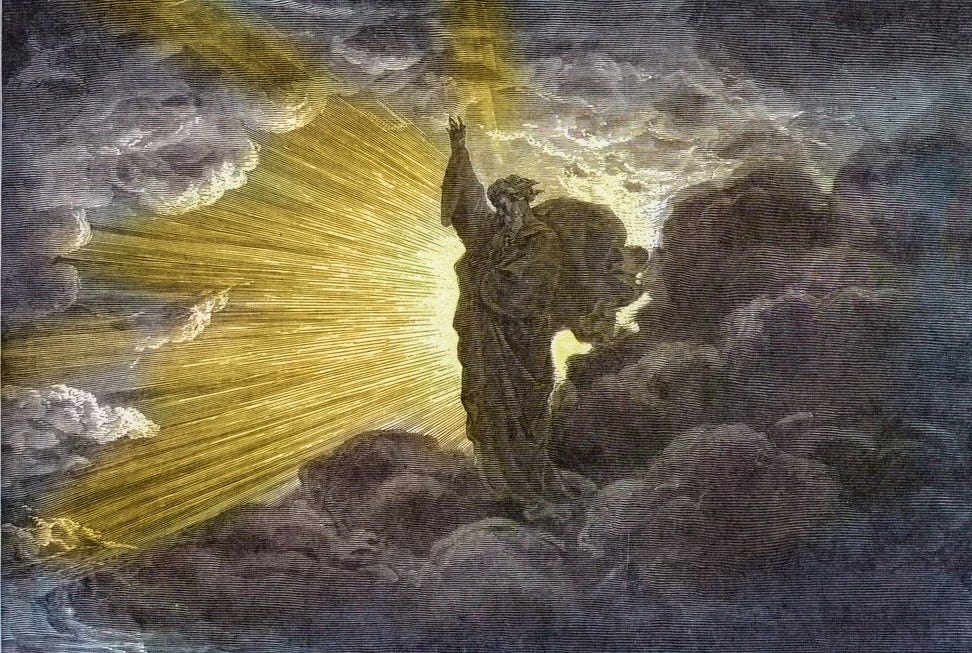
God created light on the first day. Before the Sun (the golden source of our earthly light) or the Moon (the silvery reflection of that source), there is light. It is His first command: “Let there be light.” Along with the heavens and the earth it is the first thing to exist which is Not God, and thus the foundation of all that follows. It sometimes appears as a “gotcha” to young atheists as an example of the ignorance of Biblical writers: the fools made light before the sun!
Quite obviously, ancient man knew the sun and knew the patterns of rising and setting, light and darkness, perhaps better than many today. The sun doesn’t arrive on the scene until Day Three, and yet here we are bathed in the very light of God, Who is also Himself light, and in Whom there is no darkness. By the time the source of light in our solar system arrives, the darkness of chaos has been banished. When scripture speaks of heavens and the earth it doesn’t mean sky and soil. The deep is not the oceans. The waters over which the Spirit moves are not the seas. The day and night are not cycles of the sun. All this comes later.
God does not make darkness: darkness is the absence of light. The light of the sun cannot be the light God speaks of because all creatures perceive it differently. Leaves and birds and humans are all fed differently by the sun, but the light of God feeds the human soul, and gives it life.
In the Latin1, the phrase in the Rule of Benedict often translated as “divine light” is deificum lumen. This is often rendered as “divine light,” but “deifying light”2 is a more accurate reading: the light that makes us like God. It’s often translated as “divine” on the assumption that Theosis was not accepted in the West during Benedict’s time, but this is reasoned poorly. The early Latin Life of St. Anthony used the word in this sense, and Benedict was surely familiar with it. Augustine, not generally mistaken for an Eastern Father, wrote in Sermon 192: “To make human beings gods, He was made man who was God”3. When I prepare the chalice, upon adding the water I whisper By the mystery of this water and wine may we come to share in the divinity of Christ who humbled himself to share in our humanity.”
The word use for “astonished” in this line is attonitis, which at its root means “deafened by thunder.” So here we have a kind of theophany of light and sound not unlike the Transfiguration, in which Jesus shines with a dazzling divine light in all his glory and God speaks with a voice of thunder. In the gospel of Luke, we read that “Peter and those who were with him were heavy with sleep,” but when the voice of the Father and light of the Son manifest before them, “they became fully awake” and “saw his glory and the two men who stood with him.” (Lk 9:32)
So in this line--Let us open our eyes to the divinizing light, and let us listen with astonished ears to the warning of the divine voice--the Holy Father Benedict is calling us not merely to theophany, but to theosis: allowing the full force of God’s divine light to burn away the dross and elevate us to a share in His divinity.
You must proclaim what he has done for you.
He has called you out of darkness
into his own wonderful light.
1 Peter 2:9.
et apertis oculis nostris ad deificum lumen, attonitis auribus audiamus divina cotidie clamans quid nos admonet vox dicens
-ficum, from -ficus, derived from facere: "making" or "causing"
Deos facturus qui homines erant, homo factus est qui Deus erat.
Ancient woman was there as well
Ancient woman was there as well